Lift is the aerodynamic force that acts perpendicular to the relative airflow and opposes weight, allowing an aircraft to climb, cruise, and manoeuvre. It is generated primarily by the pressure difference above and below a wing and influenced by airspeed, air density, wing area, and angle of attack.
If you’re preparing for your PPL theory exams, understanding lift is foundational. This guide explains what lift is, how it’s created, what affects it, and how it’s tested — in a way that’s clear, structured, and exam-focused.
Lift in the Context of the Four Forces of Flight
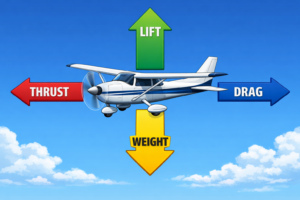
Every aircraft in flight is governed by four fundamental forces:
| Force | Direction | Function |
|---|---|---|
| Lift | Upward (perpendicular to airflow) | Opposes weight |
| Weight | Downward | Due to gravity |
| Thrust | Forward | Produced by engine/propeller |
| Drag | Rearward | Aerodynamic resistance |
Lift must at least equal weight for level flight. When lift exceeds weight, the aircraft climbs. When lift is less than weight, it descends.
For a formal definition of lift, see NASA’s aerodynamics overview:
https://www.grc.nasa.gov/www/k-12/airplane/lift1.html
How a Wing Generates Lift
Lift is primarily produced by an airfoil — the cross-sectional shape of a wing.
Two Complementary Explanations
| Theory | Core Idea | Why It Matters |
|---|---|---|
| Bernoulli’s Principle | Faster airflow over the top surface lowers pressure | Explains pressure differential |
| Newton’s Third Law | Wing deflects air downward → reaction force upward | Explains momentum change |
Bernoulli’s Principle
As air flows over the curved upper surface of a wing, it accelerates. According to Bernoulli’s principle, faster-moving air has lower static pressure. The higher pressure beneath the wing pushes upward toward the lower pressure region.
Newton’s Third Law
The wing deflects airflow downward (downwash). For every action, there is an equal and opposite reaction — meaning the air pushes the wing upward.
Both principles operate simultaneously in real flight.
See Bernoulli and Newton | Glenn Research Center | NASA for a detailed discussion.
The Lift Equation (Exam-Relevant Concept)
Lift can be expressed mathematically:
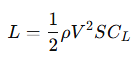
Where:
| Symbol | Meaning | Practical Interpretation |
|---|---|---|
| ρ | Air density | Decreases with altitude |
| V | Velocity | Lift increases with speed² |
| S | Wing area | Larger wings produce more lift |
| Cₗ | Coefficient of lift | Depends on angle of attack & airfoil |
Understanding this equation helps you interpret performance questions in your PPL exams.
What Affects Lift in Real Flight?
Primary Factors
- Airspeed (most influential in normal operations)
- Angle of Attack (AoA)
- Air Density (altitude & temperature)
- Wing Surface Area
Secondary Influences
- Flap configuration
- Surface contamination (ice, dirt)
- Aircraft weight (affects required lift, not lift production mechanism)
Angle of Attack: The Most Tested Concept
Angle of attack (AoA) is the angle between the wing chord line and the relative airflow — not the pitch attitude.
Increasing AoA increases lift — up to a critical point. Beyond the critical angle of attack, airflow separates and a stall occurs.
Lift vs Angle of Attack Summary
| AoA Increase | Lift | Drag | Risk |
|---|---|---|---|
| Small Increase | Increases | Slight increase | Safe |
| Near Critical | Maximum lift | High drag | Approaching stall |
| Beyond Critical | Rapid loss of lift | Very high drag | Stall |
This concept is heavily tested in PPL Air Law, Principles of Flight, and Performance exams.
Common Myths About Lift
| Myth | Reality |
|---|---|
| Air molecules must meet at the trailing edge | False — airflow does not need equal transit time |
| Lift is only caused by Bernoulli’s principle | Incomplete — Newton’s laws are also involved |
| Heavier aircraft create more lift | Incorrect — they require more lift, but lift is generated by airflow conditions |
For clarification on airflow misconceptions: Equal Transit Theory Interactive | Glenn Research Center | NASA
How Lift Changes During Flight Phases
| Phase | Lift Characteristics |
|---|---|
| Takeoff | Increasing airspeed → rapidly increasing lift |
| Climb | Lift slightly exceeds weight |
| Cruise | Lift equals weight |
| Descent | Lift slightly less than weight |
| Landing | Reduced speed, higher AoA |
Understanding these variations is essential for scenario-based exam questions.
How Lift Is Tested in Your PPL Exams
You may encounter:
- Conceptual theory questions
- Graph interpretation (Lift vs AoA)
- Density altitude calculations
- Stall recognition scenarios
- Performance-based problem solving
To master these efficiently, structured theory review combined with repeated exam-style practice is critical.
At Ground School, our Courses break down aerodynamic theory into modular lessons, while our Mock Exams simulate real test conditions — helping you move from memorization to application.
If you struggle with AoA vs pitch attitude questions or density altitude problems, targeted revision inside our system can dramatically improve exam confidence and retention.
Quick Summary Table
| Key Concept | What You Should Remember |
|---|---|
| Lift Definition | Force perpendicular to airflow |
| Main Cause | Pressure difference + downward airflow deflection |
| Most Important Variable | Airspeed |
| Stall Cause | Exceeding critical AoA |
| Exam Focus | AoA, lift equation concepts, density effects |
Frequently Asked Questions (FAQ)
Does lift require curved wings?
No. Even symmetrical airfoils produce lift when at a positive angle of attack.
Can an aircraft fly upside down?
Yes — if sufficient angle of attack and airspeed are maintained (common in aerobatics).
Why does lift decrease at high altitude?
Air density decreases with altitude, reducing the amount of air mass interacting with the wing.
Is lift stronger at higher speeds?
Yes. Lift increases with the square of velocity (V²), making speed extremely influential.
What causes a stall?
Exceeding the critical angle of attack — not low airspeed alone.
How can I best study lift for my PPL exam?
- Understand the concepts, not just definitions
- Practice interpreting graphs
- Work through timed exam questions
- Use structured theory lessons
The Courses and Mock Exams at Ground School are specifically designed to reinforce these aerodynamics fundamentals in an exam-ready format.
If you’re building a solid foundation in aerodynamics, mastering lift is your first major milestone. Once this concept clicks, everything from stalls to performance planning becomes significantly easier to understand — and easier to pass in your exams.