Weight and balance directly affect aircraft stability, stall speed, take-off distance, climb rate, fuel burn, and controllability. Exceeding maximum weight reduces performance, while an out-of-limits centre of gravity (CG) can make an aircraft unstable or uncontrollable. Understanding how weight distribution alters aerodynamic forces is essential not only for flight safety but also for passing PPL, CPL, and ATPL theory exams. This guide explains the aerodynamic principles, operational impacts, and exam-relevant concepts pilots must master.
What Is Weight & Balance in Aviation?
Weight and balance refers to:
- Total aircraft mass
- Distribution of that mass
- Location of the centre of gravity (CG) relative to defined limits
Every certified aircraft has:
- A Maximum Takeoff Weight (MTOW)
- Forward and aft CG limits
- Approved loading envelopes in the POH/AFM
The regulatory requirement to operate within these limits is defined under operational rules such as those published by the Federal Aviation Administration (FAA) and European Union Aviation Safety Agency (EASA).
- FAA Weight & Balance Handbook: https://www.faa.gov/regulations_policies/handbooks_manuals/aviation/phak
- EASA Air Ops Regulations: https://www.easa.europa.eu/en/document-library/regulations
How Aircraft Weight Affects Performance
Increased Weight Increases Stall Speed
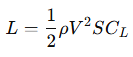
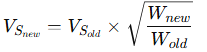
Stall speed rises with weight because more lift is required.
Lift equation:
If weight increases:
- Required lift increases
- Airspeed must increase
- Stall speed increases
Stall Speed Relationship
Performance Effects of Increased Weight
| Performance Parameter | Effect of Increased Weight |
|---|---|
| Stall Speed | Increases |
| Takeoff Distance | Increases |
| Landing Distance | Increases |
| Rate of Climb | Decreases |
| Service Ceiling | Decreases |
| Fuel Burn | Increases |
| Structural Load | Increases |
Increased Weight Increases Take-off Distance
Heavier aircraft:
- Require higher liftoff speed
- Accelerate slower
- Require longer runway
Take-off distance increases disproportionately at high weight and high density altitude.
Increased Weight Reduces Climb Performance
Climb rate depends on excess power:

As weight increases:
- Power required increases
- Excess power decreases
- Rate of climb reduces
This becomes critical in:
- Hot and high operations
- Obstacle departure procedures
- Short runway operations
How Centre of Gravity (CG) Affects Stability and Control
CG position dramatically alters aircraft handling characteristics.
Forward CG Effects
When CG moves forward:
- Increased tail-down force required
- Higher effective wing loading
- Higher stall speed
- Increased stability
- Increased takeoff distance
| Forward CG Characteristics | Impact |
|---|---|
| Higher stall speed | Reduced low-speed margin |
| Increased drag | Reduced cruise efficiency |
| More stable | Harder to flare |
| Nose-heavy feel | Higher control forces |
Aft CG Effects
When CG moves aft:
- Reduced tail-down force
- Lower stall speed (sometimes)
- Reduced stability
- Risk of deep stall
- Possible uncontrollable pitch-up
| Aft CG Characteristics | Impact |
|---|---|
| Lower stability | Sensitive pitch control |
| Reduced stall margin | Abrupt stall behavior |
| Better cruise efficiency | Less trim drag |
| Dangerous if beyond limit | Loss of recovery authority |
An extreme aft CG condition may prevent stall recovery because the elevator may lack authority to pitch nose-down.
The Federal Aviation Administration discusses CG effects extensively in its Pilot’s Handbook of Aeronautical Knowledge (Chapter on Weight and Balance).
Why Exceeding Maximum Take-off Weight Is Dangerous
Operating above MTOW affects:
- Structural integrity
- Braking capability
- Climb gradient compliance
- Regulatory legality
Structural Considerations
Aircraft certification standards (e.g., CS-23 / Part 23) define structural load limits relative to certified weights.
If exceeded:
- Load factors multiply structural stress
- Turbulence becomes more hazardous
- Insurance and legal consequences apply
Weight Distribution and Moment Calculations
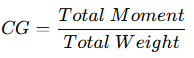
Weight and balance calculations rely on:

Where:
- Arm = distance from datum
- Moment = rotational tendency
Basic Calculation Table Example
| Item | Weight (kg) | Arm (m) | Moment (kg·m) |
|---|---|---|---|
| Empty Aircraft | 750 | 2.1 | 1575 |
| Pilot | 80 | 2.3 | 184 |
| Passenger | 75 | 2.3 | 172.5 |
| Baggage | 20 | 3.2 | 64 |
| Total | 925 | — | 1995.5 |
How Weight & Balance Appears in Pilot Exams
Exam questions often test:
- CG shift after fuel burn
- Effect of passenger movement
- Stall speed changes at higher weight
- Takeoff distance corrections
- Graph interpretation of loading envelopes
Common trick areas:
- Assuming fuel burn always moves CG forward (not always true)
- Forgetting square-root relationship for stall speed
- Misreading loading graph axes
Students preparing for PPL, CPL, or ATPL exams should practice scenario-based calculations using Ground School’s Courses and Mock Exams, which replicate real exam formats and computational question styles.
Operational Scenarios Every Pilot Should Understand
Scenario 1: Hot Day, Short Runway, Near MTOW
Risk factors:
- High density altitude
- Increased takeoff roll
- Reduced climb gradient
- Obstacle clearance concerns
Mitigation:
- Reduce fuel
- Delay departure
- Offload baggage
Scenario 2: Aft CG During Landing
Risk factors:
- Pitch sensitivity
- Over-rotation
- Bounce tendency
Mitigation:
- Recalculate loading
- Adjust trim properly
- Maintain stabilized approach
Frequently Asked Questions (FAQ)
Does heavier weight always increase stall speed?
Yes. Stall speed increases with the square root of the weight ratio.
Is an aft CG more dangerous than a forward CG?
Generally yes. A forward CG reduces performance but increases stability. An aft CG reduces stability and can make stall recovery impossible if outside limits.
Does fuel burn always move CG forward?
Not necessarily. It depends on tank location relative to datum.
Can I take off slightly above MTOW if runway is long enough?
No. Certification limits are structural and regulatory, not just performance-based.
Why do exam questions focus so heavily on weight shift?
Because improper weight distribution is a recurring cause of loss-of-control accidents.
Performance Is Physics, Not Guesswork
- Weight increases required lift.
- Lift requires airspeed.
- More airspeed requires runway and power.
- CG determines stability and controllability.
Understanding these relationships is fundamental to safe flight operations and exam success.
If you’re preparing for PPL, CPL, or ATPL theory, structured practice using Ground School’s Courses and Mock Exams ensures you not only memorize formulas but understand how they apply operationally.
Master weight and balance — and aircraft performance becomes predictable, not surprising.